 editor
Updated November 13, 2026.
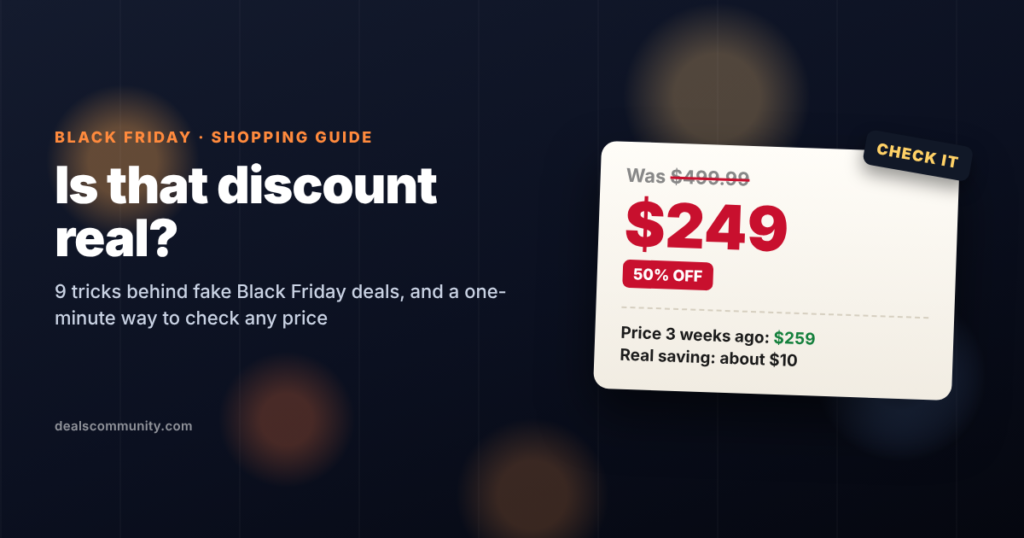
A big percentage off doesn’t always mean a good price. Some Black Friday “deals” are measured against a price the item rarely sold at. Others are special versions made just for the sale. Here are the nine most common tricks, and how to check any deal in under a minute.
The one-minute deal check
Before you buy anything on Black Friday:
- Look at the price history, not the “was” price. If today’s price matches what it cost a few weeks ago, it isn’t a real discount.
- Copy the full model number and search it at two or three other stores.
- Check who sells it: the store itself, or a marketplace seller with different return rules.
On Deals Community, our “Lowest in 30 days” badge does the first step for you: it means the current price is lower than anything we’ve tracked in the last month.
9 tricks behind fake Black Friday discounts
1. The inflated “was” price
The most common trick: a high “list price” or “compare at” price the item rarely or never sold at, so the discount looks huge. The FTC’s Guides Against Deceptive Pricing say a former price should be one the item was actually offered at, in good faith, for a reasonably substantial period, but you can’t count on every store following that. Fix: ignore the “was” price and check the price history.
2. The raise-then-cut
Some prices creep up in October, then drop “50%” on Black Friday back to where they were in September. Fix: look at the price over the last three months, not the last two weeks.
3. Special Black Friday models
Retailers sell “derivative” versions of TVs, laptops and appliances made for the sale. They look like a well-reviewed model but have a slightly different model number, and sometimes fewer HDMI ports, slower memory or a dimmer screen. Fix: compare the full model number with the one you’ve read reviews of. Our guide to Black Friday TV deals explains what to check.
4. Last year’s model at “this year’s” discount
An older model at a big discount can be a great buy, but not if the newer version is now cheaper or barely more expensive. Fix: check the model year or chip generation before comparing prices.
5. Bundles that hide the price
“Free” accessories, gift cards or extras make it hard to compare. A bundle is only a deal if you’d actually use what’s included. Fix: price the main item on its own elsewhere.
6. Fake urgency
Countdown timers, “only 2 left” and “price goes up at midnight” push you to buy before you check. Some are real; many aren’t. Fix: take one minute for the price check anyway.
7. Marketplace sellers with too-good prices
On big marketplaces, third-party sellers can list counterfeit or grey-market products, especially beauty, toys and electronics. Fix: prefer “sold by” the store or the brand, and be wary of prices far below everywhere else.
8. Fake or recycled reviews
A flood of five-star reviews can be bought, or carried over from a different product. The FTC banned fake reviews in 2024, but they still appear. Fix: read the most recent and the lowest-rated reviews, and look for photos from real buyers.
9. Store credit that you won’t use
Offers like “get $15 back for every $50” only count if you go back and spend it before it expires. Fix: compare on the cash price, and treat store credit as a bonus only if you’ll really use it.
Where real deals usually are
Not everything is a trick. Black Friday reliably brings genuine lows on TVs, headphones, Amazon devices, small kitchen appliances, vacuums and toys. Use the one-minute check, and you’ll know which ones are real.
Browse community-checked deals on our Black Friday deals page, or go straight to every store and category.
FAQ
Are Black Friday deals real?
Many are, but not all. Some discounts are measured against a ‘was’ price the item rarely sold at, and some products are special versions made for Black Friday. Checking the price history is the quickest way to tell.
How can I check if a Black Friday discount is real?
Look at the item’s price history over the last few months, compare the exact model number at two or three other stores, and check who is selling it. If the ‘deal’ price matches the normal price from a few weeks ago, it isn’t a real discount.
What is a derivative model?
It’s a version of a product made for a particular store or sale, with a slightly different model number. Black Friday TVs are the classic example: they can have fewer ports, a lower refresh rate or a dimmer panel than the model reviewers tested.
Is it legal to inflate the original price?
The FTC’s Guides Against Deceptive Pricing say a former price should be one the item was actually offered at, in good faith, for a reasonably substantial period. Some states have their own rules too. Enforcement varies, so it’s still worth checking yourself.
Are lightning deals and countdown timers real?
Sometimes. Limited-time deals do exist, but a countdown alone doesn’t prove the price is low. Check the price history before you rush to buy.
How does Deals Community check deals?
We track each product’s price over time. A ‘Lowest in 30 days’ badge means the current price is lower than anything we’ve seen in the last 30 days, and members vote on deals and flag ones that have gone up or sold out.